
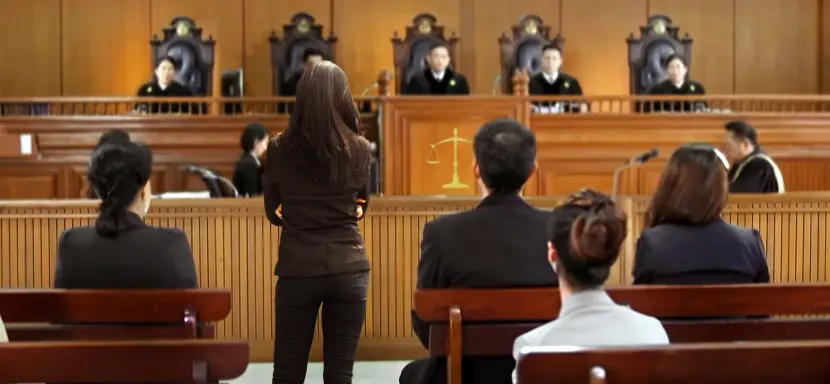
Federal grand juries are groups of citizens empowered by United States law to conduct legal proceedings. A federal grand jury is presented with evidence from the United States attorney, the prosecutor in federal criminal cases. The grand jury determines whether there is “probable cause” to believe the individual has committed a crime and should be put on trial.
Federal grand juries were originally created to protect people from being unfairly charged with federal crimes. Their job was to listen to federal prosecutors and their witnesses (usually federal law enforcement agents) present one-sided evidence (mostly hearsay) in order to return indictments if “probable cause was shown.” In fact, they only do the latter: Grand juries exist to indict people – not to protect them.
Today, federal grand juries are rightly thought of as rubber stamps for the government prosecutors. It is extremely rare for grand juries to vote against returning a federal indictment as requested by the prosecutors. When such a rare occurrence does happen, the prosecutors simply take the case to another grand jury, where they are almost guaranteed to get the indictment that they sought from the first grand jury.
Grand jury proceedings are closed to the public, the media, and even to the lawyers representing the person about to be charged. Basically, a grand jury proceeding is akin to a star chamber proceeding – unfair in every way.
Federal grand juries have wide latitude and substantial powers for gathering evidence, typically by issuing subpoenas. Of course, grand juries don’t act on their own. They are run, managed, and manipulated at every stage by federal prosecutors. A special relationship often develops between the prosecutors and the grand jurors, who serve for months at a time. Don’t be naïve — never forget that grand jurors are there to do the bidding of the prosecutors, and they do it on a daily basis.
If you are served with a grand jury subpoena, you will see that the subpoenas always have the name of a federal prosecutor and sometimes federal agents on it too. If you receive a federal grand jury subpoena, you should immediately contact a seasoned, Board-Certified criminal defense lawyer who has experience dealing with federal grand jury matters.
Jeffrey S. Weiner is a Board-Certified Criminal Trial Lawyer who has defended clients in federal grand jury investigations in the Southern District of Florida and around the country for more than 50 years.
Our attorneys have tried cases in more than 25 states and argued before the Florida Supreme Court and the United States Supreme Court. Wherever your case stands right now, we've likely stood there before — with a client's freedom on the line.
Call Us Today 305-670-9919
A grand jury must have at least 16 members, but no more than 23. A quorum requires at least 16 grand jurors present for a grand jury session.
Grand jurors may serve for as long as 18 months, and sometimes for an additional 6 months. However, there will always be a federal grand jury ready to indict you.
Some federal districts, usually the smaller districts, often have only one grand jury sitting at a time. In larger and busier federal districts such as the Southern District of Florida, the Southern District of New York, the Northern District of Illinois, and others based in large cities, multiple federal grand juries sit all the time. Grand juries for the Southern District of Florida convene at the Wilkie D. Ferguson, Jr. United States Courthouse in downtown Miami.
Twelve jurors must vote in favor of returning a federal indictment before an indictment can be presented to a federal judge. When a federal grand jury votes to return an indictment, it is said that the grand jury voted to return a “true bill.” In the rare instance, as discussed above, when there is a “no bill,” no double jeopardy issues come into play and the case can simply be presented to another grand jury.
Know that a federal grand jury may continue to investigate a particular alleged crime even after an initial indictment is returned. There are restrictions in this regard, and your criminal defense lawyer will know about them. For example, a grand jury may not legally continue its “investigation” simply to obtain additional evidence supporting the charges in a federal indictment that has already been returned.
A target letter is a written notice from the United States Attorney’s Office. It tells you that prosecutors already believe they have evidence linking you to a federal crime, and that you may be charged.
The letter often lists the criminal statutes under investigation. It may also invite you to meet with prosecutors before an indictment is sought. Do not respond to a target letter on your own. Call a federal criminal defense lawyer first.
Under the Department of Justice’s own policy, a person is a “target” if the government has substantial evidence linking them to a crime and the prosecutor thinks may become a defendant. (Source: Justice Manual 9-11.151, U.S. Department of Justice.)
Not everyone contacted during a federal investigation is a target. The Department of Justice recognizes three categories of people connected to a grand jury investigation.
Your status can change as an investigation moves forward. A witness can become a subject. A subject can become a target. This is one reason it helps to involve a lawyer as early as possible, even before a formal letter arrives.
A proffer session, sometimes called a “proffer meeting,” is a formal interview between you, your lawyer, and federal prosecutors. You answer questions about the investigation, usually under a limited, written agreement that your own words will not be used directly against you in a later prosecution.
A proffer is not full immunity. Prosecutors can still use leads from what you say to gather other evidence, and the limited protection can disappear if you are not truthful. Whether to proffer, and what to say, should only be decided after your lawyer has reviewed the government’s likely evidence against you.
A well-handled proffer can lead to a declined prosecution, reduced charges, or a cooperation agreement. A poorly handled one can hand the government evidence it did not already have.
What to Do If You Receive a Target Letter or Grand Jury Subpoena
Serving Criminal Defense Clients for Over 50 Years
It means the government wants you to testify or produce documents for a grand jury investigation. It does not necessarily mean you are a target.
A subpoena orders you to appear or produce records. A target letter tells you the government already believes you committed a crime.
You may have to appear, but you can assert your Fifth Amendment right against self-incrimination for specific questions. A lawyer should review the subpoena before you respond.
No. Only jurors, the prosecutor, the witness, an interpreter if needed, and a court reporter may be present. You can step outside to consult your lawyer between questions.
The investigation continues without you. Prosecutors typically move forward and seek an indictment from the grand jury.
No. A proffer is an informal, out-of-court interview with prosecutors. Grand jury testimony is formal, on the record, and given directly to the grand jurors.
Under a standard proffer agreement, your direct statements generally cannot be used against you at trial, but the government can still use leads from what you say. Lying during a proffer can void that protection.
A true bill is the grand jury’s vote to return an indictment. At least 12 of the 16 to 23 grand jurors must agree.
It depends on the complexity of the case. A grand jury’s term is typically 18 months, and can be extended by up to 6 months.
Federal grand juries for the Southern District of Florida sit at the Wilkie D. Ferguson, Jr. United States Courthouse, 400 North Miami Avenue, Miami, Florida 33128. The U.S. Attorney’s Office for the Southern District of Florida empanels these grand juries and presents evidence to them.
Are You Worried About a Federal Grand Jury Indictment?
If you received a federal grand jury subpoena or a target letter, call Jeffrey S. Weiner, P.A. at (305) 670-9919. The firm is available 24 hours a day, 7 days a week, and offers free initial consultations.
You may call our office 24 hours a day, 7 days a week. We are always ready to consult with you, whether
by telephone consultation, a meeting in our office, or a visit if you are incarcerated. All communications
are confidential and protected by the attorney-client privilege.
“*“Indicates Required Fields
"*" indicates required fields
Two Datran Center, Suite 1910
9130 South Dadeland Boulevard
Miami, FL 33156

Copyright © 2026 Jeffrey S. Weiner, P.A. All Rights Reserved. Disclaimer | Site Map | Privacy Policy.
*Images are obtained under license from Canva and other third-party stock image providers, with attribution included where required.
Digital Marketing By: 
